
An art installation: AltErEtt… AltErEgo

AltErEtt or AltErEgo, February-March 2014,
an art installation, in Evangerista kunst -og kulturhus.
In memoriam: Mona Nordaas (1958-2016)
Evanger, a tiny village in Norway, was home to Norwegian artist Mona Nordaas, who made colourful installations from materials and objects that had been thrown out as garbage. Putting together things that were damaged, ugly, or no longer modern or useful, she created art which was both pleasing and intriguing, beautiful and thought-provoking.
This text is a rewrite of two essays which I wrote about Mona’s work in 2014, as submissions for Coursera mooc “Live!: A History of Art for Artists, Animators and Gamers”.
photos: Mona Nordaas

Mona’s combined café and art gallery, Evangerista kunst -og kulturhus, is pleasant, with a warm, quiet atmosphere. The music is relaxing, and quiet enough to allow conversation and reflection.

The room is furnished with tables and chairs in different colours and materials, an old piano, a large, old-fashioned cafe counter, and a bright red sofa which cuts the space in half.
Entering the bathroom, you find yourself in another world, painted in glowing shades of blue, green and turquoise and inhabited by numerous unwanted toy dinosaurs of every shape, size and colour.
At the far end of the café, flimsy curtains on either side of a small stage are pulled open, to reveal AltErEtt, or AltErEgo, the installation on which Mona is currently working. In Norwegian, the names AltErEtt and AltErEgo play on the words of which they are made up, forming a deliberate quadruple meaning: Alter-et means the altar, while alt-er-ett means all is one. Alter ego can also be read as alt-er-ego – all is ego.

The installation stands tall on the small stage, functioning simultaneously as an altar and a representation of a person, bearing within itself countless large and small elements: a Buddha; embellishments and ornaments; a tray holding tiny cups; a harlequin; a marionette; orderly and complex collections of objects, mirrors, lights…
Every surface of the installation holds small objects that could fall at the slightest push, just as we present an attractive, but fragile, outer layer, protecting our inner vulnerability. The Buddha sits at the back, centred within a flimsy body with limbs on either side. Near the front, the tray and the tiny cups signal a readiness to serve and share. In front of the Buddha, the harlequin looks out, ready for mischief. A marionette leaps from the top – his strings pulled from within or without?
To me, the presence of contemplative and mischievous figures, the collections of objects in warm colours on one side and cold colours on the other side, and the partly covered mirrors at the back, reminiscent of yin-yang symbols, simultaneously symbolize balance and complexity.
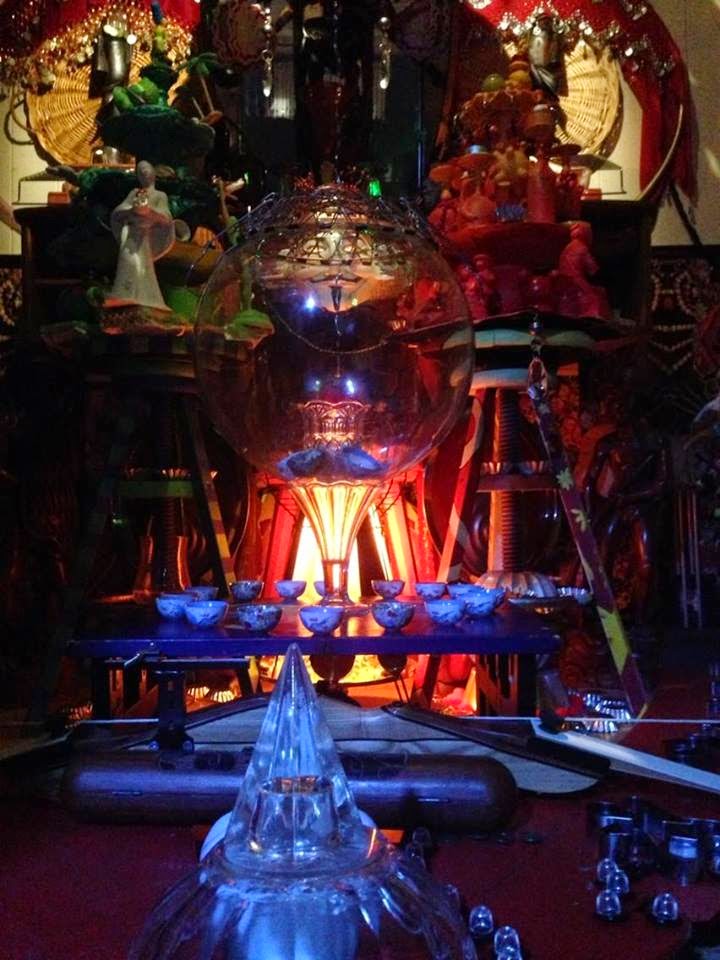

Bathing in the gentle hustle and bustle of the café, I reflect… Can we view all existence as one? Can we see all as part of our-selves? Are these views mutually exclusive? If all is one, why are we so wasteful? Ultimately, do we choose who and what we are? It is interesting to consider this work as an allegory of contemporary times, as it has so many layers, possible interpretations, and points of entry.
In the act of reusing throw-away objects, the work has an intended meaning in the form of an overt political message about waste and materialism; an undisguised critique of the pervasive throw-away culture of overconsumerism in which we all take part. On other levels this work acts as an allegory of contemporary times in the way it reveals hidden meanings related to life, identity and human complexity; it can be seen down-up or up-down, and we can approach it from many different angles.

At a superficial level, like AltErEtt or AltErEgo, each one of us makes up a whole, appearing as a more or less coherent entity. Yet, in the deeper layers of our being, we are made up of distinct, yet indivisible, yet contradictory elements; we are simultaneously selfish and selfless, good and bad, constructive and destructive. Each of us embodies femininity and masculinity, optimism and pessimism, harmony and disharmony. AltErEtt or AltErEgo can be seen as a beautiful and expressive manifestation of the many facets of human nature; even elements that are unattractive, perhaps even ugly, contribute to the beauty of the finished work.

In particular,though, AltErEtt or AltErEgo reminds us of our mortality. Like the discarded artefacts that make up the work – and like the work created from these artefacts – each one of us will one day cease to be an entity, and all that we once were will fall apart. If we are unable to stop waste and over-consumption, even the beautiful and vulnerable world which we now inhabit may one day be only a memory – to be remembered by whom?

To return to the name AltErEtt or AltErEgo, the work functions as an altar – but, for the worship of what or whom? There is a Buddha hidden deep in the core of the structure, but also an angel, mirrors, a glass sphere – a crystal ball…? Which aspects of self make up our ego? Do we all sometimes – or always – have one or more alter egos? Are our individual selves parts of a greater one? Is every being part of a one, part of a whole – which in turn is a sum of its elements? How do we reconcile all is one, all is ego, alter ego – with the worship of an other which is implied by the presence of an altar?
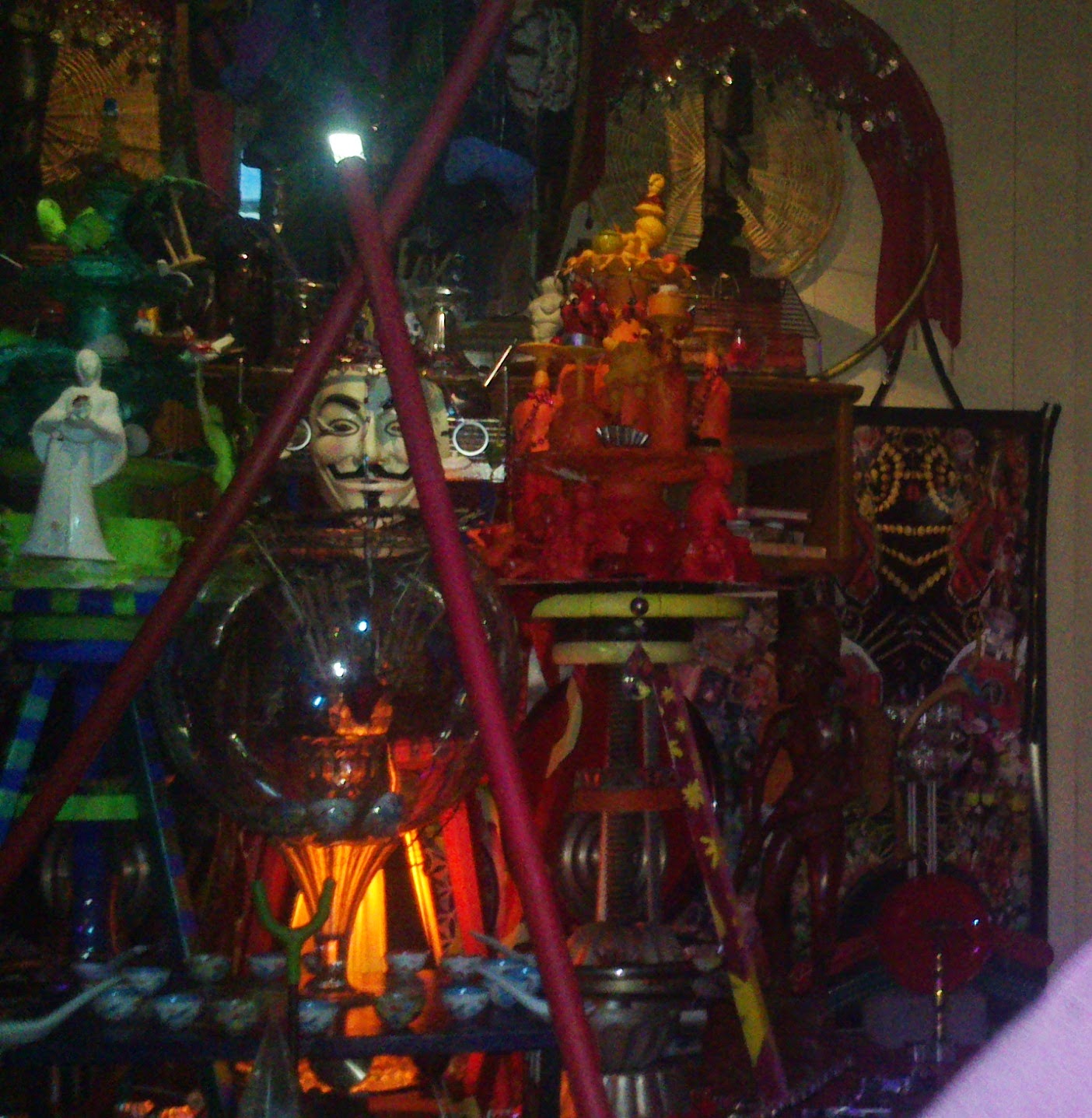

AltErEtt/AltErEgo is quite a large installation; the combination of a small child and an extremely complex, flimsy and breakable construction is not to be recommended – thankfully, on this particular occasion disaster was avoided…


Second language and special needs teacher based in Voss in Norway, with a particular interest in the challenges faced by learners with disabilities. Fully bilingual in English and Norwegian and semi-fluent in French and Arabic. Mother of seven great kids aged 9-33, one with Down syndrome. Interested in life skills such as parenting, home-making, health, entrepreneurship, learning and languages.
Wow! What a great description! Looking foreward ro studying this closer tomorrow with new \”glasses\” on:)
Thank you! Writing this has certainly opened my eyes and made me see it differently – I also look forward to seeing it again… 🙂